CLM – Thinking with the Church, and Helping the Church Think
By Robert Fontana
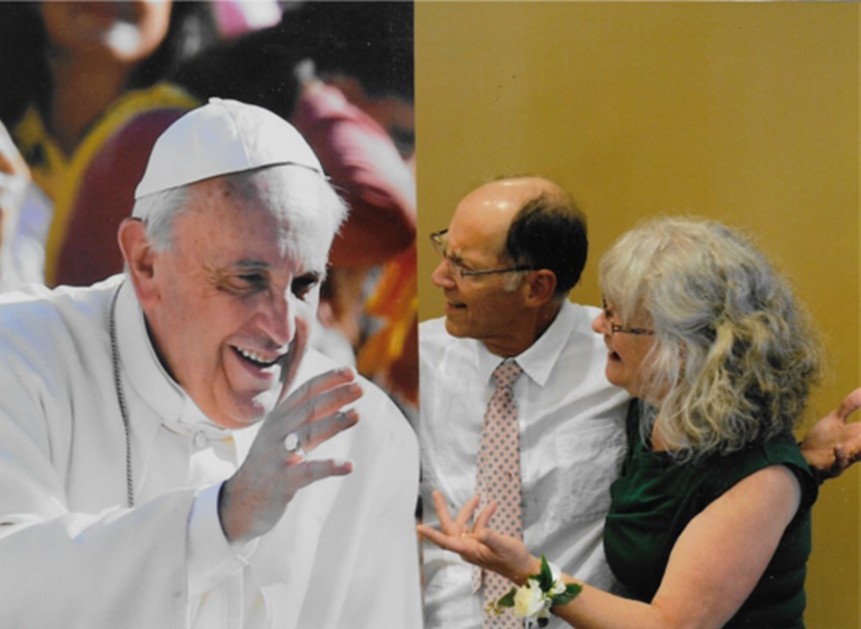
We are grateful for your prayers and financial support. Because of you, Catholic Life Ministries (CLM) has offered a variety of outreaches over the years since we began our ministry in 1990:
Faith and fun camps for families; Taize youth ministry; sacramental preparation classes for Confirmation and Marriage; Camp St. Francis service weekends to repair homes for the elderly and poor; retreats for adults, youth, and couples; family workshops to prepare for Advent and Christmas; and counseling for individuals, couples, and families.
One of our major outreaches is this publication, The Troubadour, and online essays. Through these we offer our best effort to follow the wisdom of Fr. Judge, founder of the modern Cenacle movement, to “think with the Church.” However, we add to that the hard-learned wisdom from our 44 years of working in Catholic ministry: “help the Church think.”
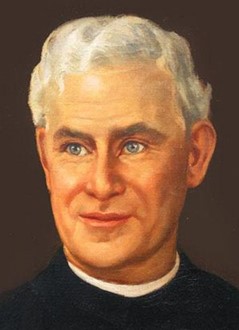
Fr. Judge, in insisting that we think with the Church, was not demanding blind loyalty to what Catholic leaders might be saying and doing in a particular circumstance. Father Judge went deeply into what the Church believes by studying the Scriptures, the second and third generations of Christian writers, the lives of the saints, and the teachings of Church councils. This, of course, included praying with the Church by praying the daily office, and observing the liturgical year. In doing so, he developed an inner capacity, rooted in the faith of the Church, to discern the impulses of the Holy Spirit to “think with the Church” while confronting the new and complex issues of his day (early 1900’s).
Fr. Judge would encourage us to do the same as much as we can within the circumstances of our own lives. I agree with his sentiments…to a point.
For one, few of us lay people, other than professional lay ministers, have the time or interest to delve deeply into the many ways the faith of the Church is known and passed down from generation to generation. Most of the laity must rely on Church leaders, clergy and lay, to do this work for us. There lies the rub: the practice of many clerics, from past times into the present, from parish priests to bishops, has been to interpret the phrase “think with the Church” as “pray, pay, and obey!”
That attitude reflects a view of the Church as a monarchy with a small caste of men who rule and the rest of us who are “ruled.” This is still so evident in our church structure at all levels. Lay people serve on parish councils, finance councils, diocesan pastoral councils, and Lay Review Boards, etc., all of which are ADVISORY. We pay all the bills but only get to offer advice on issues of importance.
Working at the Diocese of Yakima, I had a meeting with Bishop George (later Cardinal George of Chicago). He said to me, “Robert, before we get to our agenda, I need to talk to you about your difficulty with authority in the Church.” (The context: inadequate supervision of lay employees by pastors, low salaries, mistreatment of women in ministry.)
I was surprised, not sure what he was talking about. “WHAT? I’m a good Catholic boy!” He continued, “Well, some folks have told me you think there is a need for a union of lay employees.”
I replied, “Oh that. Bishop, I have learned that in the Church the clergy will always be management, and lay employees will always be labor, and never the twain shall meet.” He said, “Oh, is that all? You’re right.” That was the end of our discussion; and we continued with our meeting.
This conversation happened before the Catholic world imploded over clergy sex abuse crisis. Back then I was addressing issues such as salaries, equitable personnel policies, inclusion of lay people on church boards, and expanding the role of the permanent diaconate. The sexual, physical, and spiritual abuse of children by clergy and other church ministers, and the coverup of this abuse by church leaders demonstrated to Lori and me that the voices of conscientious lay women and men were needed more than ever.
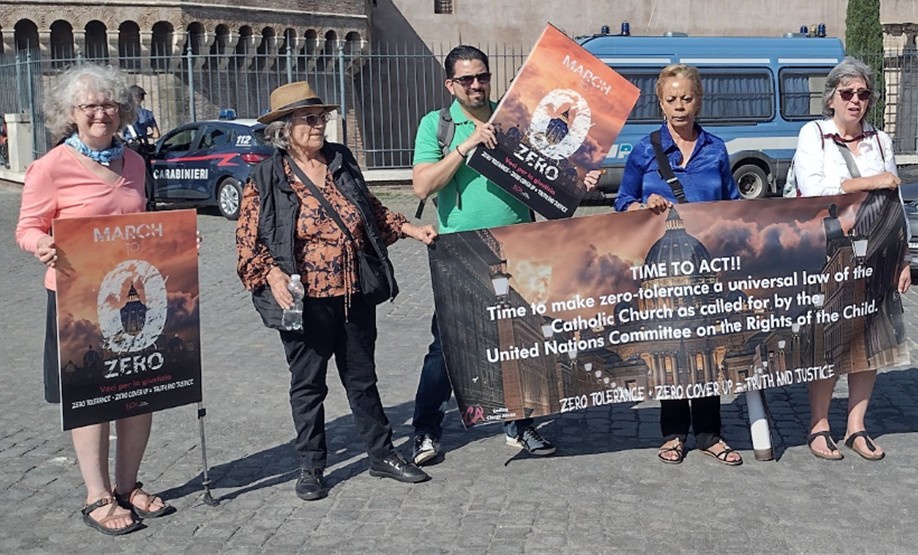
It is no longer enough to “think with the Church.” We must also “help the Church think!”
Pope Francis, apparently, would agree with us (or, perhaps, we are agreeing with him). He initiated a “synodal” process in the Catholic Church that reached out to every parish in the world. It was and is a process of listening to the real experiences of people, allowing these experiences to shape the conversation and discernment of how the Holy Spirit is leading the Church.
Lay women and men, for the first time ever, or at least since the time of the early Church, met with bishops and priests, religious women and men, to respond to questions generated from the worldwide synodal process, share experiences, and listen together, in prayer, to the Holy Spirit.
Through your prayers and financial support, Catholic Life Ministries has offered the Church community a variety of ministries and outreaches. In the essays we print online and in print with The Troubadour, we try, with you, to “Think with the Church, and Help the Church Think.”
______________________________________________________________________________
PLEASE CONSIDER SUPPORTING CATHOLIC LIFE MINISTRIES
Once a year we ask you to discern if God is calling you to join in the work that we do. It is work that you believe in:
- Counseling couples, individuals, and families in a non-profit clinical practice that offers a sliding scale to make our services available to people of all income levels;
- Spiritual and faith formation for adults through retreats and Cenacle faith communities;Marriage enrichment and marriage preparation workshops;
- Advocacy for persons, the vulnerable and those living on the margins: migrants and asylum seekers, the unborn, and, following Pope Francis’ encyclical Laudato Si, our planet;
- Essays on living the Christian life within the complexity of the 21st century (“thinking with the Church and helping the Church think”).

To support Catholic Life Ministries:
1. Make a donation online at https://www.catholiclifeministries.org/donate/
2. Make a check payable to CLM. Mail to CLM, 1827 NE 58th St, #B, Seattle, WA 98105. (Your donation covers everything from stamps, the websites, gas expenses, subsidizing clients who are underemployed, rental of retreat sites, refreshments, materials for retreats, and our salaries.)
3. Commit to praying for the Fontanas and CLM. Let us know you’ll pray for us! Email us at Robert@catholiclifeministries.org. Send us your prayer requests which we remember every Thursday. Pray the following prayer which we use when we pray for you:
“O loving God, Father, Son, and Holy Spirit, we commend to you this day our love and service. We pray also, that in the providence of our every day life, we may be mindful of the poor and spiritually abandoned, those who do not know your love or the love of their neighbor. Be with and bless the community and mission of Catholic Life Ministries. Make CLM an instrument for drawing the busy and the bored, those in and out of church, into the love and communion of the Trinity. We ask this in the name of Jesus and through the intercession of St. Mary and St. Joseph and all the saints. Amen!”
Christian Marriage is Beautiful…and Hard
By Robert Fontana
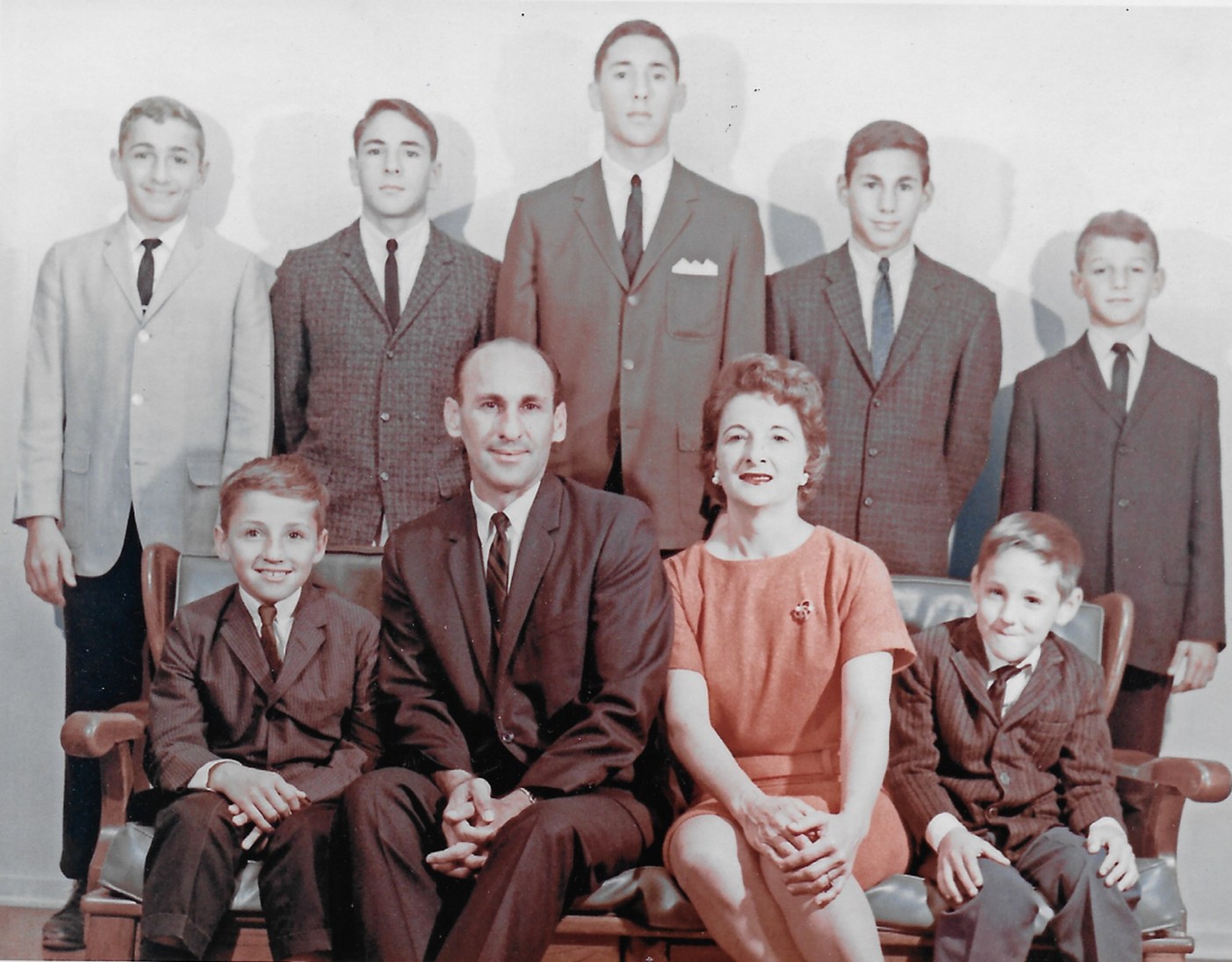
My mother tells the story that after 20 years of marriage, she and Dad could agree on only three things.
They were married.
They had seven sons. And…
Divorce was not an option (murder…maybe, but not divorce!).
Yes, Mom and Dad had a Christian courtship. They were married after the early morning Mass at Assumption Catholic Church, in Donaldsonville, Louisiana, settling there near Dad’s family. And, following the Catholic method of family planning, their son, the first of seven sons, was born 11 months later.
All was not roses. I have a letter from early in their marriage. Dad wrote to Mom, begging her to come back home. Apparently, she had left in a huff to live with her mother, a three-hour drive away. Mom and Dad were experiencing conflict based on what marriage educators call the “unsolvable problem” in every marriage: Mom was not Dad; Dad was not Mom. Living together, they bumped into their differences; and they had not yet learned to resolve them peacefully. Their marriage, at times, was a tug-of-war. They pulled in opposite directions until somebody finally gave in, or they had a fight.
This wasn’t the whole story. They both loved listening to and playing music, enjoyed musical theater, played tennis, gathered with extended family on weekends, and went to church on Sundays. Knowing Mom, she probably said the rosary every day and went to Mass during the week. But their Catholic Christian faith did not teach them how to manage their differences peacefully, differences in temperament, personality, and expectations, such as how they were going to support a family, parent children, and deal with each other’s families. The tug-of-war continued off and on and, at times, escalated into fighting.
When spouses fight, neither is listening to the other. All couples have a “demon dance,” a negative pattern of interaction with each other when the gloves come off, and each spouse is trying to win the argument or, worse, get revenge and hurt their spouse who may have just hurt them. The “demon dance” develops slowly over time when spouses don’t effectively address differences. Rather, they react to each other in ways that reinforce hurt, resentment, distance, and loneliness. These reactions become a pattern, a “demon dance,” into which warring spouses easily step.

Spouse A makes a critical comment about Spouse B who responds with a smirk. Spouse A does some eye-rolling, and Spouse B speaks the “truth” with a certain tone, and Spouse A says, “Don’t give me that tone!” Spouse B withdraws to silence, and Spouse A gets loud and…
I don’t know what Mom’s and Dad’s demon dance was but, after 20 years, it must have been bad. Remember the only things they could agree on? They were not alone. They were part of the post-war generation of marriages in a rapidly changing America in which the rules that governed conventional marriage – husband as head of the house – were changing. Women were demanding to be treated as equals. In 1946, 1 in 4 marriages ended in divorce. By the late 70’s / early 80’s, the divorce rate jumped to half of all marriages.
What guides today’s marriages? Today’s marriages are no longer governed by roles in which men work and take care of all things outside the house (car, lawn, etc.), and women, who may also work, take care of the small children and everything inside the house. For many people, what shapes their marriage is their careers and ambitions for material success. Some people have “political marriages,” marriages for the sake of gaining access to power in society. Celebrities may use marriage to further their fan base with no intention of longevity or fidelity. Other people, coming from trauma, may use marriage to run away from a difficult childhood home life.
Couples not guided by vows shaped by Christian faith easily place careers, kids’ commitments, pet care, hobbies, or their car upkeep ahead of their marriage. They focus on what social commentators call the “Poison P’s” – Power, Position, Possessions, and Privilege – all made possible by money. When the marriage is second-place, behind every other good commitment, spouses become strangers to one another.

Christian marriage is also hard because life is hard. Many of us didn’t grow up in a family that could give us the consistency of love and healthy examples of working through conflict without yelling and screaming. For many reasons – poverty, sickness, tragedy, sexual and physical abuse, mental illness, drug and alcohol abuse, angry parents, bullying siblings, emotional neglect – individuals, though married in church, bring to their marriages the unresolved pain and hurt from childhood. When emotional needs are not met in marriage, faith notwithstanding, people can react to each other with survival skills learned in childhood. They might yell or withdraw into silence, avoid conflict by joking, become overly critical or logical, analyze for motives, lecture, threaten with consequences, and even boss their spouses around.
They never learned how to listen to each other for understanding, show compassion or validate one another’s emotions, or work together for a solution to the problem that both spouses could live with without resentment.
This was Mom’s and Dad’s challenge. 20 years of marriage, and they were strangers to one another. So guided by their vows and their faith, rather than going to divorce court, they went to a prayer meeting, where they experienced God’s love which turned their lives upside down.
In welcoming God into their marriage, they learned to make their relationship their primary commitment, even over parenting their seven sons. They developed a truly Christian view for married love. They worked to replace their tug-of-war marriage with one focused on seeking the good of the other and finding unity, friendship, and understanding. With God’s help and the help of a prayer community, they began pulling together rather than against each other. And their marriage became the love story that inspired my marriage.
Christian marriage is beautiful and HARD!
Citizenship for Migrants and Refugees (AND NOT DEPORTATION!)
By Lori and Robert Fontana

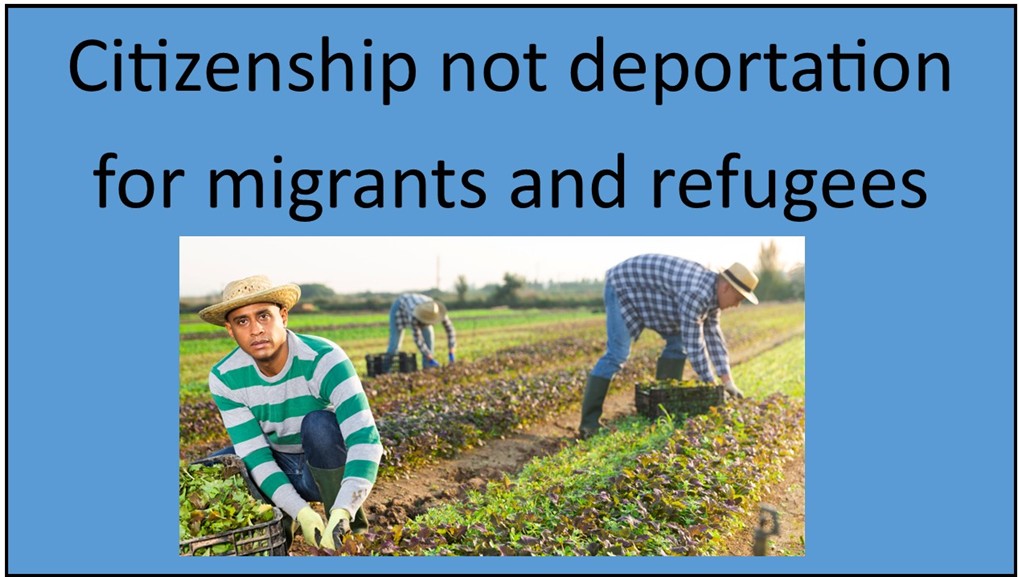
Let’s start a national campaign to promote a path towards citizenship for migrants and refugees. Mass deportations are not the answer. Migrants and refugees, by and large, are hard-working, family oriented, and law-abiding members of our communities. Some are professional people, others carpenters, electricians, and owners of small stores. But many are the laborers doing the physical work of caring for our elderly, cleaning our homes and businesses, driving taxis, working at airports and slaughterhouses, and picking our crops.
Write the Republican lawmakers from your state and insist that they find the moral courage to give these good people a path to citizenship as did Ronald Reagan, one of our most conservative presidents, did when he signed the Immigration Reform and Control Act of 1986!
What you can do to promote a pathway to citizenship for migrants and refugees:
1. Get informed. Fact check any information you learn about undocumented migrants and refugees. One argument for deporting migrants is that they are “all rapists, murderers, and criminals!” The majority of undocumented migrants and refugees are good people seeking to build a new life in the U.S.. But do they commit more crime than native born citizens? The data says “no.” Although there are not good national statistics on this issue, looking at state arrest records shows that undocumented persons are as much as 40% less likely to commit crime than native-born citizens (see: https://www.factcheck.org/2018/06/is-illegal-immigration-linked-to-more-or-less-crime/)
2. Learn about the real contributions of undocumented persons and refugees to U.S. society: “…There are currently an estimated 11 million individuals living in the United States without legal status, the vast majority of whom are working, paying taxes, and contributing in both economic and non-economic ways to their community, often starting their own businesses, and playing integral roles in agriculture, construction, hospitality, and other industries that are essential to the U.S. economy.” (see: https://www.newamericaneconomy.org/issues/undocumented-immigrants/)
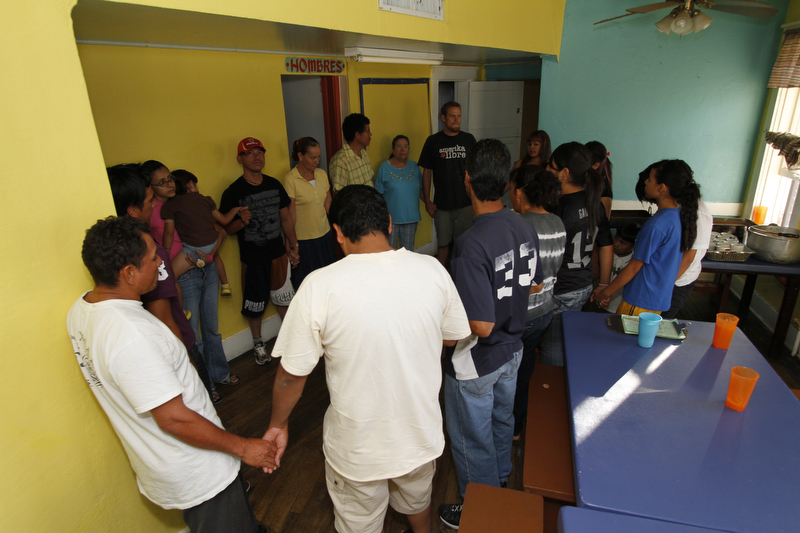
3. Learn what the Bible actually says about how one should treat foreigners: “The foreigner residing among you must be treated as your native-born. Love them as yourself, for you were foreigners in Egypt. I am the LORD your God.” Leviticus 19:34. “Whoever oppresses the poor shows contempt for their Maker, but whoever is kind to the needy honors God.” – Proverbs 14:31 “Then the king will say to those on his right, ‘Come, you who are blessed by my Father. Inherit the kingdom prepared for you from the foundation of the world. For I was….a stranger and you welcomed me.’” Matthew 25:35
4. Get organized. Meet with your friends and neighbors, especially those who are politically conservative. Have a conversation about the above. Remind folks that both the Biblical view of migration and Catholic social teaching state that people have a right to leave their homeland in search of a better life. And yes, Catholic social teaching also holds that governments have a responsibility to manage their country’s borders. The southern border is closed. Now is the time to advocate, in the spirit of Ronald Reagan (and guided by the Holy Spirit), for a path towards citizenship for migrants and refugees.
a. Meet with the congressional and senatorial representatives from your state, both parties. They have offices in the districts they represent. Talk with them and/or their staffs. Listen to their ideas; advocate for an end to mass deportations and urge them to create a path towards citizenship!
b. Organize a peaceful rally in front of their offices.
c. Write your newspaper; keep it up week after week.
5. Pray for the success of this campaign.
Prayer for the election of a new pope
by Fr. Sam Fontana
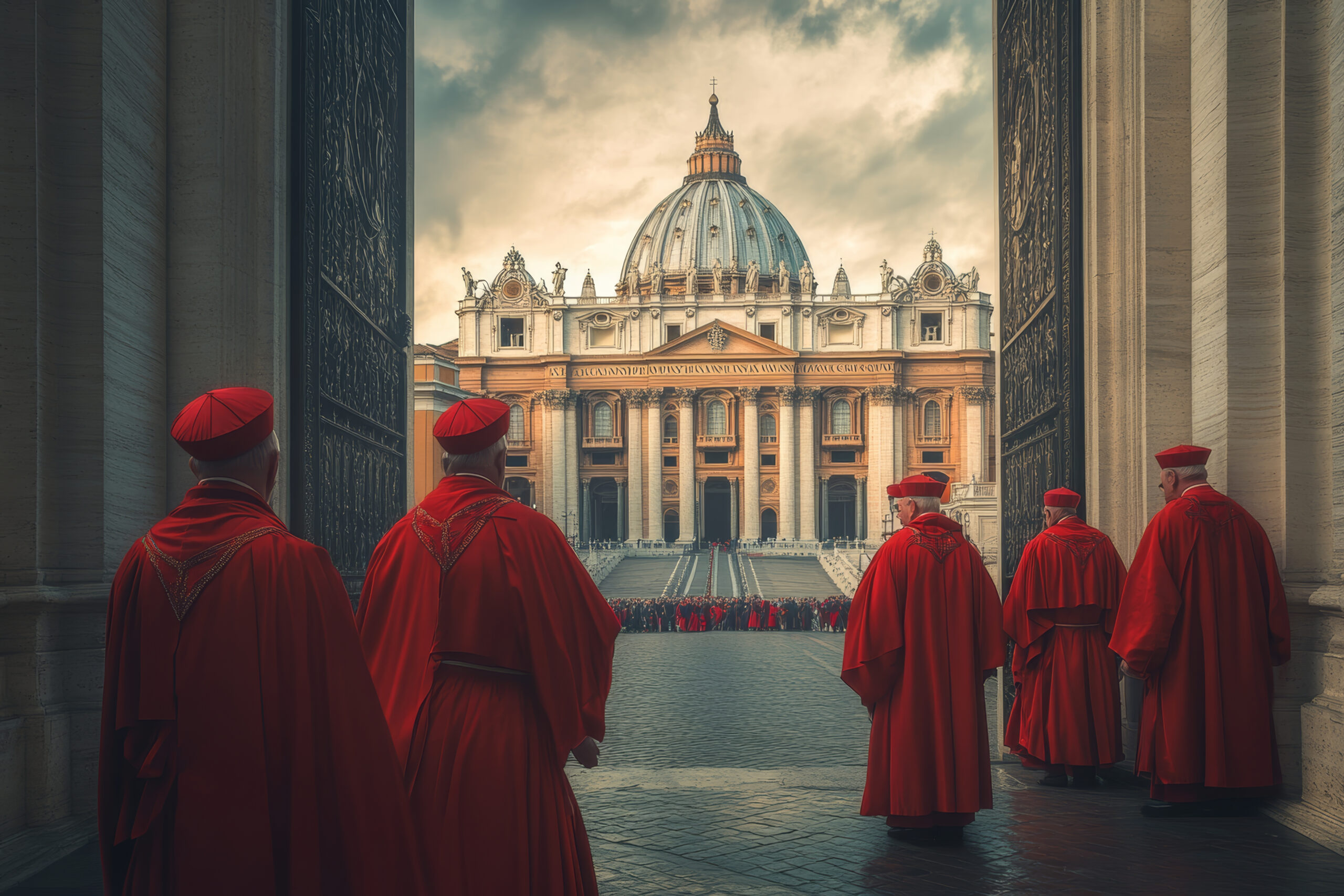
Come, Holy Spirit, fill the hearts of the Cardinal electors gathered in Rome and kindle in them the fire of your love. Fill them with your manifold gifts and make them docile to your promptings.
Come, O Spirit of Wisdom, purify and sanctify their minds, that they may listen and speak in truth.
Come, O Spirit of Peace, bind them together in charity and make them one in mind and heart.
Come, O Holy Paraclete, make known to them the man you have chosen, who will lead the Church in holiness and fidelity to the Gospel.
Heavenly Father, in union with the whole, Church, we humbly and confidently beg you, with your Son, to send the Holy Spirit upon the Cardinals of the Church. Through the power and inspiration of the Spirit, may your will be perfectly accomplished through them. Through Christ our Lord. Amen.
Gratitude for Pope Francis…and disappointment
By Robert Fontana
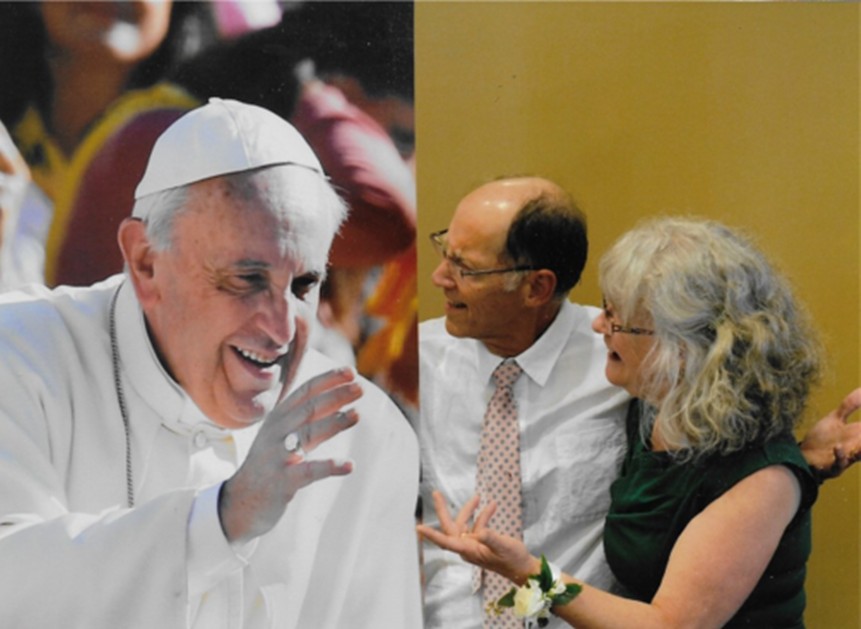
Jorge Mario Bergoglio was elected pope following the retirement of Benedict XVI (formerly Joseph Cardinal Ratzinger). I was surprised, like most people, by the words and behaviors of the new pope. He was very different from his two predecessors. He…
¨ chose the name Francis and as the new pope, asked us to pray for him.
¨ moved into an apartment to live alongside others.
¨ ate in a communal dining room.
¨ for his first papal trip, visited migrants on an island near Italy.
¨ washed the feet of Muslim and Christian inmates at a prison at Good Friday services.
¨ visited the wall in Ciudad Juarez adjacent to El Paso advocating for the rights and dignity of migrants.
¨ wrote an encyclical urgently challenging us all to care for the earth, our common home.
¨ instructed the clergy to leave the confines of the parish to mix with the people, saying a pastor should “smell like his sheep.” And…the church must be a “field hospital” more concerned with healing the wounds of suffering people than with defending its own interests. And…the Eucharist is “not a prize for the perfect but a generous medicine and food for the weak.”
¨ advocated for peace and justice for refugees everywhere, especially those living in Gaza.
¨ called a Catholic parish in Gaza daily to express his love and learn how the people were surviving.
¨ spoke with and welcomed individuals and groups formerly marginalized by the church (divorced and remarried, gay and lesbian).
¨ apologized for the sins of the church against children and youth through clergy sex abuse and destruction of native culture through boarding schools.
¨ initiated a new way of being church through the synodal process in which clergy and laity alike pray through and discuss issues of church life to discern guidance of the Holy Spirit.
¨ appointed most of the world’s cardinals, making the college of cardinals a truly international body.
I am grateful for the above. Pope Francis loved Jesus and sought to be a pastor rather than a king. Remember the first words out of his mouth when he referred to himself not as pope but as bishop:
Brothers and sisters, good evening. You all know that the duty of the Conclave was to give a bishop to Rome. It seems that my brother Cardinals have gone almost to the ends of the earth to get him… but here we are.
He demonstrated that the church is a communion of disciples of Jesus, not a monarchy, corporation, or fund-raising apparatus. He showed us how to advocate and work for the common good, for what is life-giving for all people, not just Catholics. That is a witness sorely needed today.
However, there are areas of Francis’ ministry that were disappointing.
Clergy sex abuse: He had a lackluster approach to protecting minors and vulnerable adults from sexual predators in the church. His encouragement to whistleblowers who seek to expose sexual predators and bishops who protect these criminals was weak. Survivors of clergy sex abuse want a clear and unambiguous change to canon law that will suspend a cleric from ministry permanently for even one offense against a minor or vulnerable adult. (I would add to that to suspend any bishop or church leader who protected the offending cleric.)
Clericalism: I wish Francis had done more to ask the Catholic people how we experience clericalism in the church and what we think ought to be done about it. Lori and I have worked with many good, kind, compassionate, and competent priests. And we have worked with many who were simply bullies. They were bullies to sacristans and altar servers, bullies to their staff, and even bullies when visiting the sick and dying.
I think the problem goes back to their formation in seminary with the notion that the priest is an “alter-Cristo.” He is the sacramental sign of Christ, head of the church. At Mass he is the last one to enter the church like a king entering court. He gives himself communion. And when Mass concludes, he blesses the rest of us, leaving himself out of the blessing. This is overstated and needs to change if the pastor is to “smell like the sheep.”
Women: Where would the Catholic Church be without the women who do most of the work in Catholic parishes, Catholic schools, Catholic dioceses, and social services? Yet women cannot preach, baptize, witness weddings, anoint the sick sacramentally, or preside at the burying of the dead. It is way past time that women be welcomed to the Sacrament of Holy Orders as deacons.
Celibacy: Pope Francis listened to pleas from South American bishops for a married clergy but caved to the backlash that came from traditionalists who demanded that he maintain celibacy for priests. This is silly and sinful. We have married clergy in the Eastern Catholic Churches, and we allow married men who were pastors of Protestant churches and converted to Catholicism to be ordained priests. The bishops of Amazonia wanted to make the Eucharist and other Sacraments readily available to people who may only see a priest once a year. Pope Francis said “NO!” I guess celibacy is still more important to church leaders than is the Eucharist. Otherwise we would dispense of that discipline for the priesthood and ordain married men so that the Eucharist and other Sacraments can be readily available to all no matter where they live.
I am most grateful for the life and ministry of Pope Francis, Bishop of Rome. He gave us the leadership that we needed at this time in history. I trust that the Holy Spirit will find a worthy successor whom I hope will take up some of the above issues.
Eternal rest grant unto him, O Lord; and may perpetual light shine upon him!
Jubilee of Hope – Personal Reflections
By Chris Koehler, Director of Missions & Immigrant Affairs, Archdiocese of Seattle
What does it mean for me to be a person of hope?

Hope is not a belief that things will turn out well or the expectation of some specific good thing. For me, hope is the belief in the intrinsic good or doing good. In that sense, “hope” is an action verb: the act of doing something good is in itself The Good, and I believe that good always comes from doing good. Even when it is surrounded by a multitude of bad things, they do not detract from or diminish the good.
Hope is an act of creation. I have hope because I because I act in hope, and I witness others acting in hope
Hope is not about achieving some far-off goal. Our actions matter in and of themselves, regardless of what effect comes from them, because those acts build the world. They build a world of hope. Even when done in seemingly small ways – alleviating someone’s pain for just a moment, say – it has profound effects.
Hope is not a way of ignoring problems or pretending like everything is great when it’s not. It’s a way of facing challenges head on and saying, “Well, things are not great right now, but I can do good now and other good will come of that. I may never see what good comes of it, but I have faith that it will.”
What is a Scripture text that speaks to you of the hope you have in God?
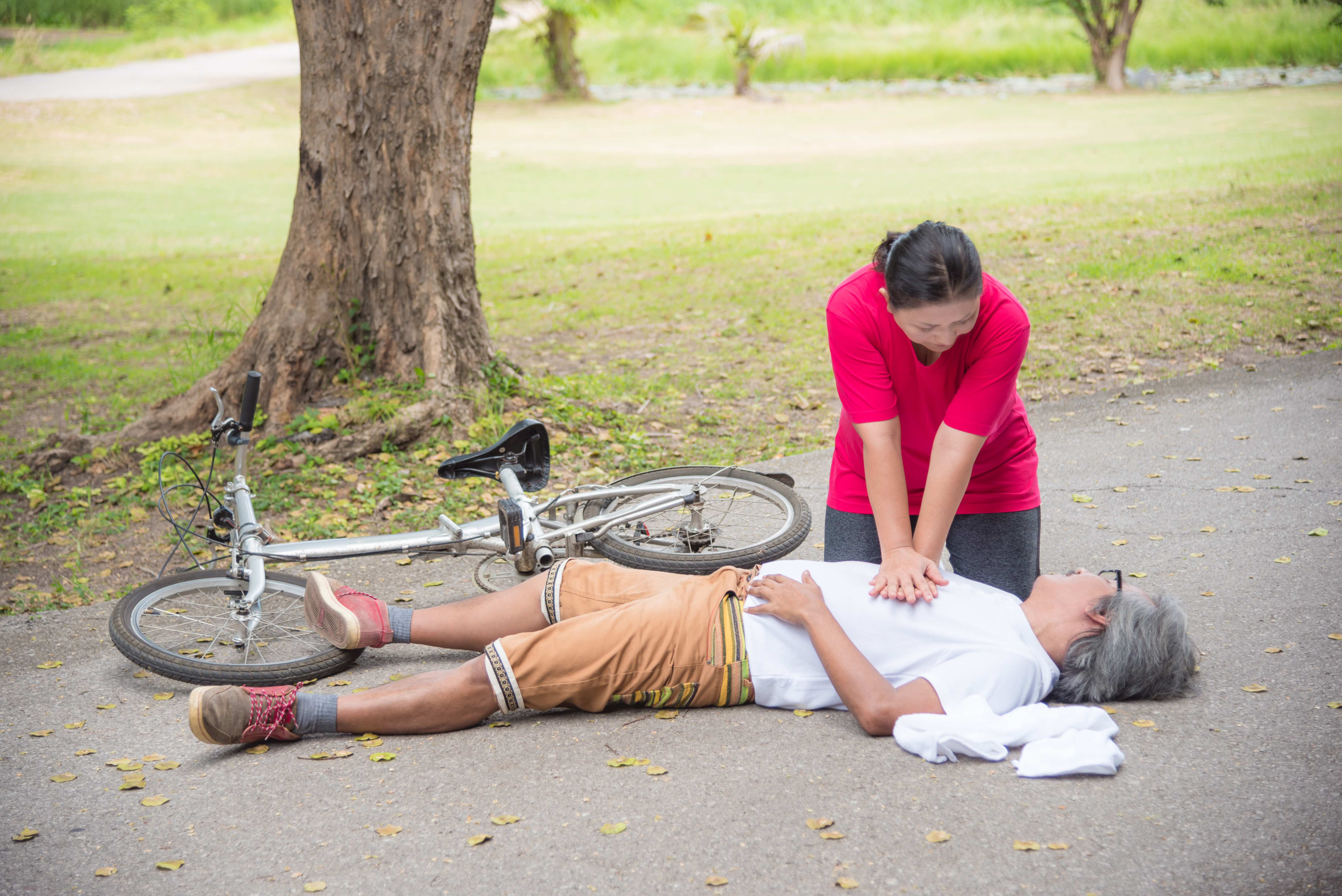
Let’s think about the Good Samaritan for a moment
“A man was going down from Jerusalem to Jericho, when he was attacked by robbers. They stripped him of his clothes, beat him and went away, leaving him half dead. A priest happened to be going down the same road, and when he saw the man, he passed by on the other side. So too, a Levite, when he came to the place and saw him, passed by on the other side. But a Samaritan, as he traveled, came where the man was; and when he saw him, he took pity on him. He went to him and bandaged his wounds, pouring on oil and wine. Then he put the man on his own donkey, brought him to an inn and took care of him. The next day he took out two denarii and gave them to the innkeeper. ‘Look after him,’ he said, ‘and when I return, I will reimburse you for any extra expense you may have.’
Our God is a God of love and compassion.
Put yourself in this story for a moment.
First, take the place of the man left for dead. Beaten. Robbed. Stripped of your clothes. Left lying in a ditch. Two men cross the road to avoid you; men who are expected to be of deep moral character. You are too weak to call out. Then a different man stops; a man from a hated group. He tends to your wounds and bandages them. He takes you to an inn and pays for your stay and food and to be taken care of.
How was your hope affected? Did you lose hope? Did you regain hope? What were you feeling – anger, surprise, relief? If your sense of hope changed, why was that? What triggered that change?
Now, take the place of the Samaritan. You have found someone half-dead. You clothe him and tend to his wounds and take him to an inn. You use your own money to ensure he has the care he needs.
As you leave the inn, what are you thinking and feeling? Are you certain he will survive? What is your hope grounded in?
I meet Good Samaritans every day. They fill the world with hope. None of us know how things will turn out, and things often don’t turn out as we expected. But that does not diminish the hope that was nurtured by their actions.
How do you nurture hope and where do you see signs of hope?
I sympathize with people who are shutting out the news. There is so much that is hurtful and saddening and depressing. And much else that is sensationalistic, negative depictions of what’s happening in the world. It feels bad, but it is not the whole story. I want to stay informed because to do so otherwise is to shut out the reality of our lives. It results in isolation. I don’t want to turn a blind eye to the suffering of the man in the roadside ditch. I want to know what people are doing to make things better, to be inspired and to be challenged as well. I want to be in community with others, both those who are suffering and those who are helping.
I subscribe to Facebook accounts about positive and fun things. I watch shows that have stories about people helping each other. These are everywhere. I watch Finding Your Roots, a show where celebrities discover and recover the stories of their family who came before them. Every episode raises up the stories of courageous and hopeful people who overcome some form of adversity. They never do it alone. Those stories are hard to hear, but they are full of hope.
I practice “positive gossip”—sharing stories about human goodness. That’s helps to assuage other people’s cynicism, as well as my own. Some people have remarked how positive I am, which is funny because I am a naturally pessimistic person…but I choose positivity. I choose to see the good that is often clouded by the bad that is happening.
I see the incredible hopefulness of younger generations. The ones I know are the most globally informed and concerned generation I’ve ever known. They can be full of anxiety and fear and frustration, but they are focused on what they can do to make things better and they expect our leaders to do the same.
On a more personal and somewhat silly note, I watch horror movies by myself. Late at night with the lights off. After everyone else has gone to bed. I love a good scare…not a jump scare or gore, but a slowly creeping dread. Why do I mention that here? Because the horror movies I like always have hope deeply embedded in the story. There’s a group of people trying to help each other get through. There’s often an unlooked-for stroke of luck (or blessing?). There’s often someone who starts out bad but is changed in the face of someone else’s suffering and does the right thing in the end.
What is a piece of wisdom that you would like to share?
Hope is about community.
There’s lots of science and solid research that’s been done about hope. One thing that has been shown over and over is that when we look at what people are really like, they do good things all the time, and they do extraordinarily good things a lot of the time.
We are all weak at times. We can despair. We can give up. We can curse the weight of the responsibilities we carry, and we can fail to live up to those responsibilities. We can lose hope. If we are alone, that is dangerous.
But when we are in community, we can rely on the strength of others. They nurture us when we despair. They forgive us when we cannot forgive ourselves. They help us to uncover the hope we thought we had lost. They show us the grace of God. And we can do the same others in turn.
So let me close by extolling the value and the fundamental importance of growing, nurturing, and maintaining a healthy community. On full of both joy and hope. Do that and all else will fall into place.
The Story of the Universe, of Earth, of Humans, and the Easter story
by Robert Fontana
“O God, you have been our refuge from all generations. Before the sun was born, before the galaxies came forth, and the Great Beginning, you are God from eternity and forever.” (Adapted from Psalm 90:1)

I remember the first time I saw photos from the Hubble telescope. THEY WERE STUNNING! Hubble captured images of stars, galaxies, nebulas and so much more, thousands of light years from Earth.
Hubble scientists focused its lens on a dark section of space and saw an astounding 50,000 galaxies. THAT’S GALAXIES NOT JUST STARS! Our own Milky Way Galaxy has an estimated 100-400 billion stars. EGADS! Our sun is a star. Imagine 400 billion of them times 50,000 that makes…wait let me ask one of my grands… “Ty, compute this for me!” There are unimaginable numbers of stars in the universe which is incomprehensibly vast.
Scientists estimate the universe to be 13.79 billion years old and Earth to be about 4.55 billion years old, give or take a few hundred million years.
Keep in mind that the “stuff” that makes up the stars and the planets, including Earth and all the creatures that inhabit the Earth, have a common origin in the beginning of the universe. Fr. Thomas Berry, who described himself as Geologian (Geologist + Theologian), wrote,
“To tell the full story of a single particle we must tell the story of the universe, for each particle is in some way intimately present to every other particle in the universe.” (The Universe Story – https://thomasberry.org/quotes/)
And…
“It takes a universe to bring human beings into being.” (Evening Thoughts – https://thomasberry.org/quotes/)
We humans emerged on earth only about 300,000 years ago. We are latecomers to life on the planet. According to Astronomy Workshop, if one could compress “the time the Universe existed into the span of a single day, with the Big Bang occurring at the stroke of midnight…humans crash the party at 11:59:56 pm, just four seconds before the end of the day.” (See https://janus.astro.umd.edu/front/pages/links/Time1.html)

In universe time, Jesus lived and died a nano-second ago.
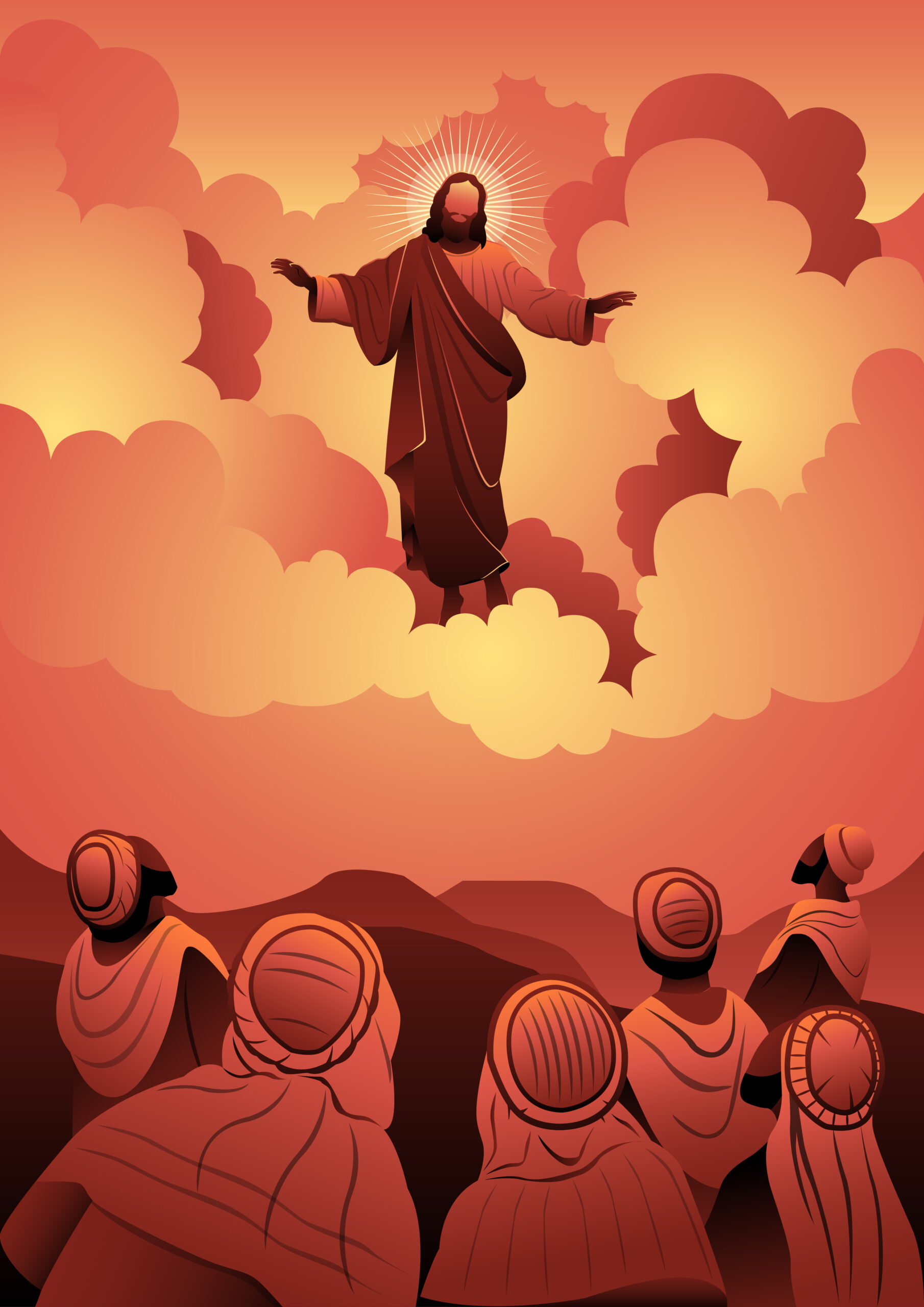
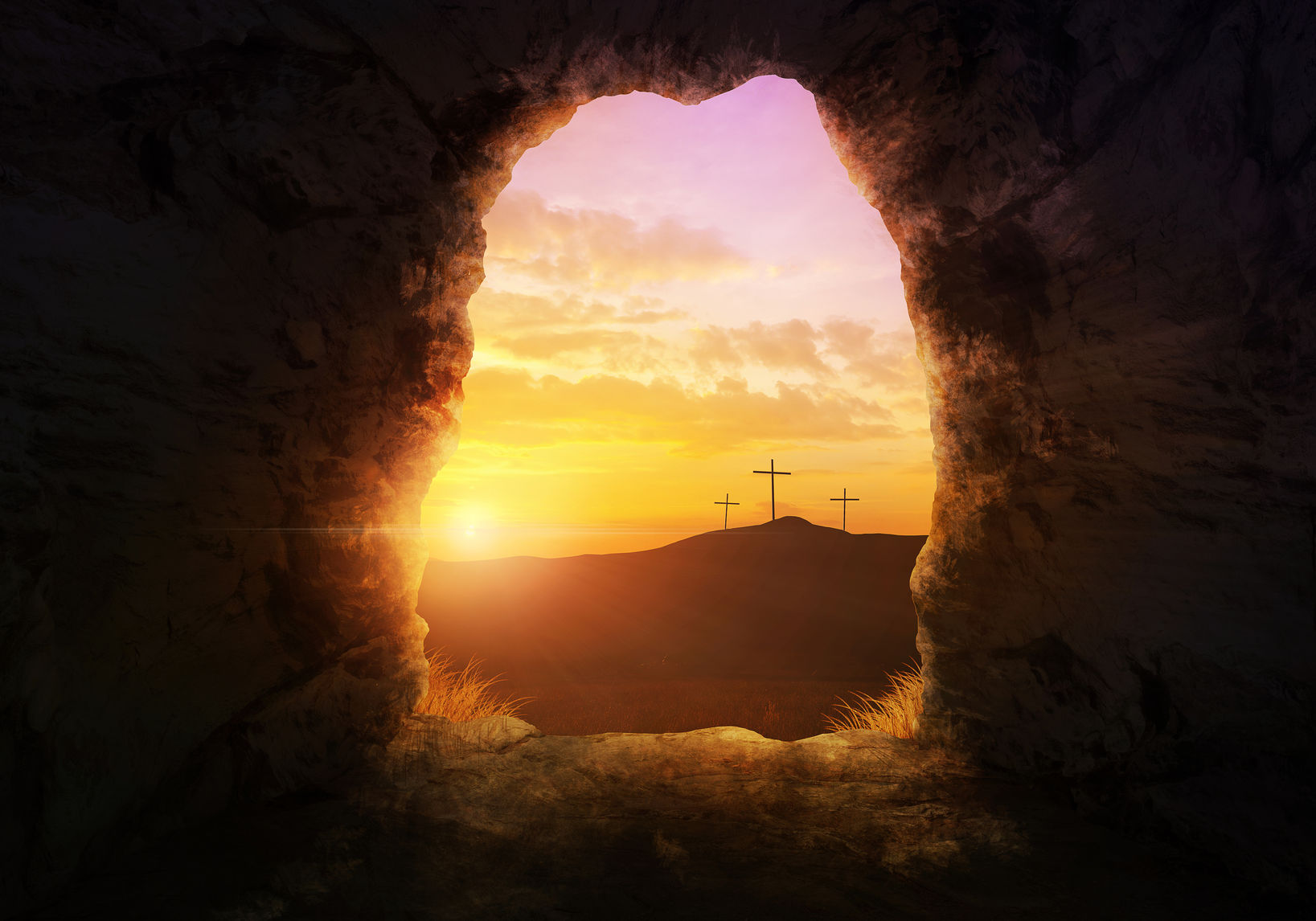
As I marvel at the vastness of the universe story, I feel a tension between science and the Easter story, the Paschal Mystery: that God’s beloved son died for our sins, rose from the dead, was seen by a handful of his companions, ascended into heaven, and will come again at the end of time. All who are faithful to Jesus will live forever in paradise, and the unfaithful, well…
WHOA! It’s a story that sounds too good to be true. Too neat, too convenient. Why do only the followers of Jesus get to see the Risen Jesus? Why does he not show himself risen to all people? Can we really trust their story? No one can see him now, but don’t worry, he’s coming back. And when he does, he is going to wield a sword to strike down all the ungodly and bring everlasting life to his faithful followers. In the meanwhile, we try to live lives guided by the Holy Spirit as we wait for Jesus to come again.
AND HOW DOES ALL THAT MESH WITH THE EVIDENCE FROM SCIENCE ON HOW THE UNIVERSE BEGAN, THE GALAXIES CAME FORTH, THE EARTH WAS FORMED AND HUMANS EMERGED?
I can just hear my agnostic college roommate saying, “With the evidence you have from science about the age and formation of the universe, do you believe this S**T?”
And, YES, I do believe, but it is not without some doubt and uncertainty.
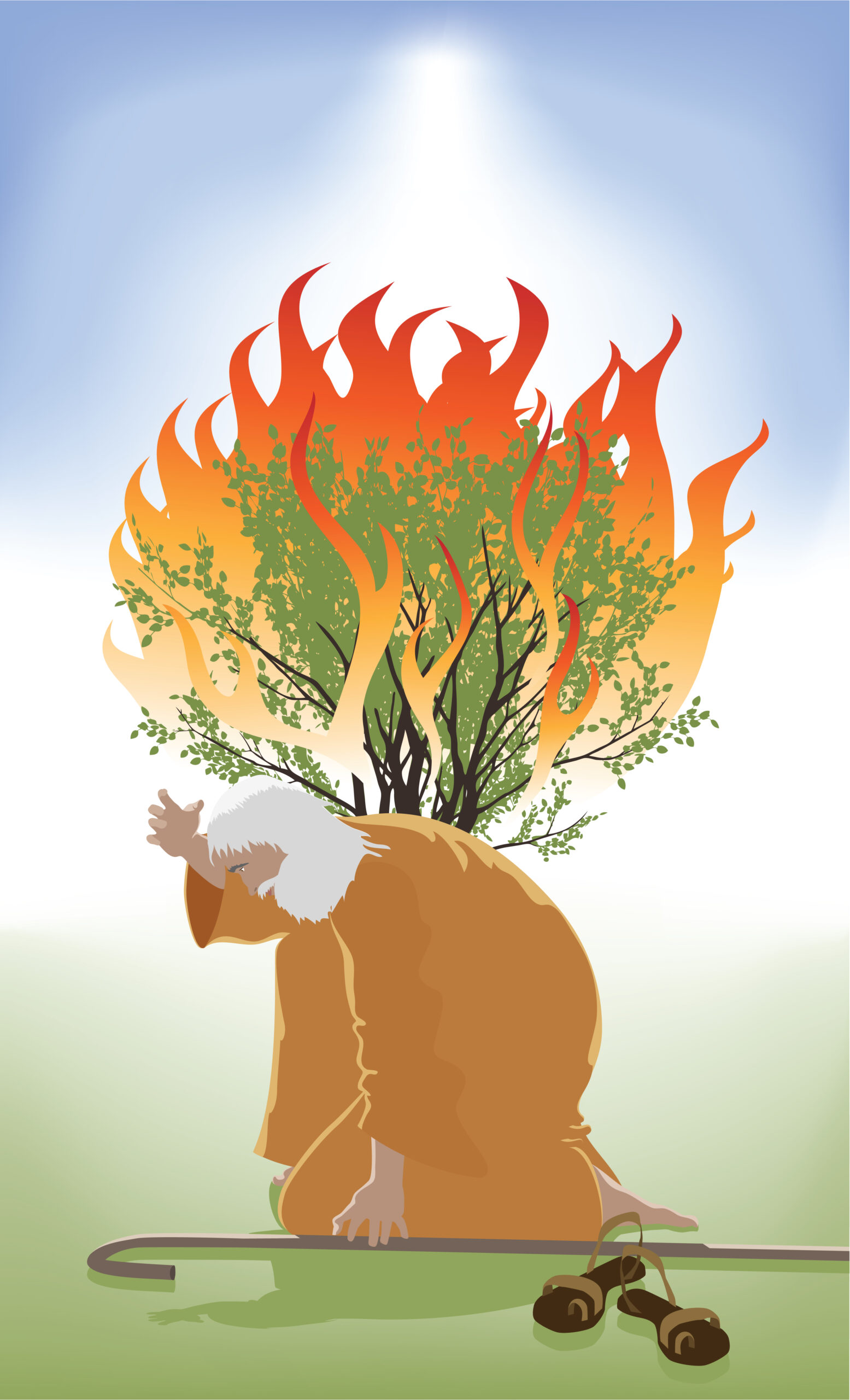
Why do I believe the Easter story as presented in the Scriptures, proclaimed by the Christian community, and embraced by the saints? I think the primary reason is that I have experienced God’s love and forgiveness through my faith long before I began to grapple with the evidence from science. Initially, when I first saw the images of deep space taken by Hubble, I felt really scared. How could the story of Jesus and the story of the universe both by true? I felt like Moses when he was confronted by God in the burning bush. Do I throw water on the bush? Do I run away? Or do I follow God’s command to Moses: “Take off your sandals, for the place where you are standing is holy ground.” (Exodus 3:5) I chose the Moses route. And, yes, it was, and still is, a choice.
I also take my doubts to St. Paul. Reading his description of the appearances of Jesus gives me great comfort. Paul wrote his first letter to the Corinthians some 25 years after the death and resurrection of Jesus. It is the earliest written account that we have of the resurrection appearances, 15-20 years earlier than the written Gospels:
For I handed on to you as of first importance what I also received: that Christ died for our sins in accordance with the scriptures; that he was buried; that he was raised on the third day in accordance with the scriptures; that he appeared to Cephas, then to the Twelve. After that, he appeared to more than five hundred brothers at once, most of whom are still living, though some have fallen asleep. After that he appeared to James, then to all the apostles. Last of all, as to one born abnormally, he appeared to me. (1 Cor 15:3-9)
Paul’s summary of the appearances of Jesus is remarkable. Do I trust what he says? Do I trust what the Christian community has continued to say about Jesus for the past 2000 years even if Jesus’ life on Earth is just a nanosecond in universe time? YES!
During this Easter season I hold onto both remarkable stories as true: the story of the unfolding universe on which the human story is radically dependent, and the story of the saving work of Jesus through his life, death, resurrection, and sending of the Holy Spirit, on which the Christian story is radically dependent.
Alleluia! Happy, holy Easter!
A head scratcher: Hebrews 5:8 – “Son though he was, he learned obedience through suffering.”
By Robert Fontana

No, no, no! Jesus was the perfect child. He was naturally obedient to his parents, at least except for his little escape to the temple without telling Joseph and Mary, when they were in a tizzy not knowing where he was. Then how would he have needed to learn obedience to God through what he suffered?
Our faith teaches us that Jesus suffered for our sins through his death on the cross. As St. Paul writes:
We proclaim Christ crucified, a stumbling block to Jews and foolishness to Gentiles, but to those who are called, Jews and Greeks alike, Christ the power of God and the wisdom of God. 1 Cor 1:23-24
Indeed, the entire sacramental life of the Catholic church is based on this conviction that we participate in the meaning of Christ’s death whenever we celebrate any of the Sacraments, but especially the sacraments of Eucharist and Baptism:
For as often as you eat this bread and drink this cup, you proclaim the death of the Lord until he comes. 1 Cor 11:26
…are you unaware that we who were baptized into Christ Jesus were baptized into his death? We were indeed buried with him through baptism into death, so that, just as Christ was raised from the dead by the glory of the Father, we too might live in newness of life. Rom 6:3-5
The New Testament writers understood that Jesus is the Suffering Servant written about by Isaiah (Isaiah 52:13 – 53:12):
But he was pierced for our offenses, crushed for our sins; upon him was the chastisement that makes us whole, by his stripes we were healed. We had all gone astray like sheep, each following his own way; but the LORD laid upon him the guilt of us all.
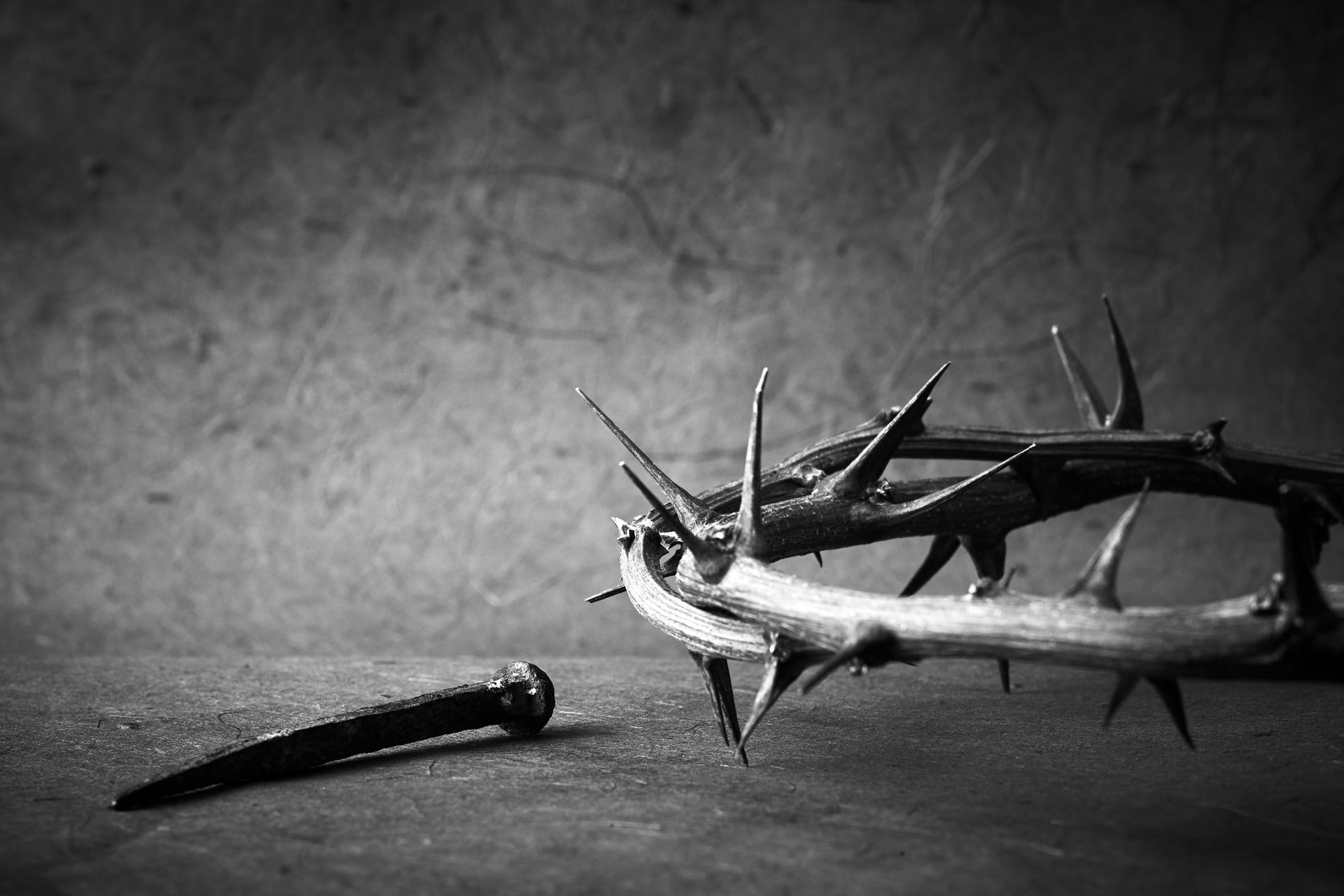
The letter to the Hebrews teaches us that suffering for Jesus had a purpose, to teach him to obey God’s will for his life. This didn’t happen just in the garden of Gethsemane when he prayed that the suffering that lay before him be taken away. No, Jesus was being trained from childhood to bear a variety of different forms of painful events that enabled him to literally take up his cross at Calvary. The ancient Christian hymn cited by St. Paul in his letter to the Philippians underscores this very point:
…though he was in the form of God, he did not regard equality with God something to be grasped. Rather, he emptied himself, taking the form of a slave, coming in human likeness; and found human in appearance, he humbled himself, becoming obedient to death, even death on a cross. Philippians 2:6-8
How did Jesus during his lifetime learn obedience through suffering? This is what I think.
(1) Jesus learned to say “yes” to God by saying “no” to temptation. Jesus was not just tempted when he encountered the Devil during his 40-day fast in the wilderness. He was tempted throughout his entire life with real temptations, as we all face. We have a glimpse of how Jesus was tempted when we read how he struggled in the garden to face the suffering and death that were coming: “Abba, Father, take this cup from me.” Mark 14:36
Did Jesus struggle in a similar way with other temptations? Why not? He was fully human in all ways but sin. He must have had to wrestle with the seven deadly sins – pride, anger, greed, envy, gluttony, lust, and laziness – as we all do.
For we do not have a high priest who is unable to sympathize with our weaknesses, but one who has similarly been tested in every way, yet without sin. Hebrews 4:15
(2) Jesus learned obedience to God by saying “no” to family expectations. His family and relatives from Nazareth were good Jews. They were just as offended by Jesus’ behavior as were the religious leaders, so much so that family members tried to remove Jesus from circulation, and the synagogue leaders of Nazareth had him expelled:
When his relatives heard of this, they set out to seize him, for they said, “He is out of his mind.” Mark 3:21
He came to Nazareth, where he had grown up, and went according to his custom into the synagogue on the sabbath day. They rose up, drove him out of the town, and led him to the brow of the hill on which their town had been built, to hurl him down headlong. Luke 4:16-29
I don’t think we can overstate how difficult this was for him in a kinship culture in which family relationships dominated Jewish life. Loyalty is expected, even demanded. Yet Jesus must break through family expectations to truly listen to his Father’s will for his life.

(3) Jesus learned obedience to God’s will by suffering through opposition from Jewish religious leaders. These leaders watched what Jesus was doing and were outraged by it: breaking Sabbath regulations; eating and drinking with tax collectors and prostitutes (sinners); including women as his disciples; healing servants of the hated Romans; and insisting that God’s love was breaking into the world through him. Their only explanation for such scandalous behavior was that Jesus must be possessed:
The scribes who had come from Jerusalem said, “He is possessed by Beelzebul,” and “By the prince of demons he drives out demons.” Mark 3:22
(4) Jesus learned obedience to God by suffering through the departure of many of his disciples who lost confidence in him. This loss of confidence began before the great betrayal of Jesus by his disciples on the night he was betrayed. John records that after Jesus finished a series of teachings, many of his disciples found what he said was so hard to take; and they left him. It got so bad that Jesus turned to the Twelve and said, “Do you also want to leave?” John 6:67-71 The Twelve, led by Peter, decided to stay.

(5) Jesus learned obedience to God as he confronted the reality that the “Good News” he was preaching will get him killed. As Jesus set his eyes on Jerusalem (Luke 9:51), it became clear to him that his Gospel message of the Kingdom of God would not find a home among his Jewish listeners. This clarified things for him. He knew that if he continued doing what he was doing, his future path was one of suffering and death. He was ready for it. He had been training for this moment his entire life. This is echoed in the letter to the Hebrews:
In the days when he was in the flesh, he offered prayers and supplications with loud cries and tears to the one who was able to save him from death, and he was heard because of his reverence. Son though he was, he learned obedience from what he suffered; and when he was made perfect, he became the source of eternal salvation for all who obey him. Hebrews 5:7-9
Jesus’ suffering as the “Suffering Servant” did not begin with Good Friday. He was being trained for his passion and death, for his Good Friday, throughout his entire life, as he learned to obey God’s will for him despite temptations, the opposition of religious leaders, the rejection by family and relatives from Nazareth, and the abandonment by some of his disciples and friends.
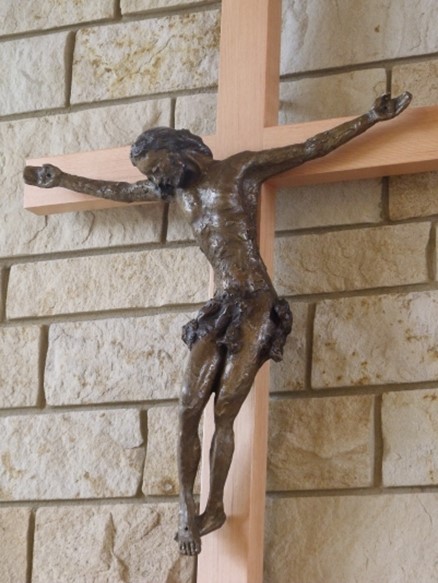
Perhaps the same is true for us. We too learn to do what is right, to do God’s will for our life, through our struggles with temptations, bad religion, and inadequate expectations from family and friends. The “Serenity Prayer” has a line that reads, “Suffering is the pathway to peace.” Jesus shows us the truth of that wisdom. He learned obedience through suffering; so do we.
A woman bishop, a president, and a solution to the migrant and refugee crisis
By Robert Fontana
You may have never knowingly met men and women who are living in the United States without documentation, but you have certainly benefited from their presence. As Episcopal bishop Mariann Edgar Budde reminded the newly elected president on inauguration day, these are…
“…the people who pick our crops and clean our office buildings, who labor in poultry farms and meat packing plants, who wash the dishes after we eat in restaurants and work the night shifts in hospitals. They may not be citizens or have the proper documentation, but the vast majority of immigrants are not criminals. They pay taxes and are good neighbors. They are faithful members of our churches and mosques, synagogues, and temples.”[1]
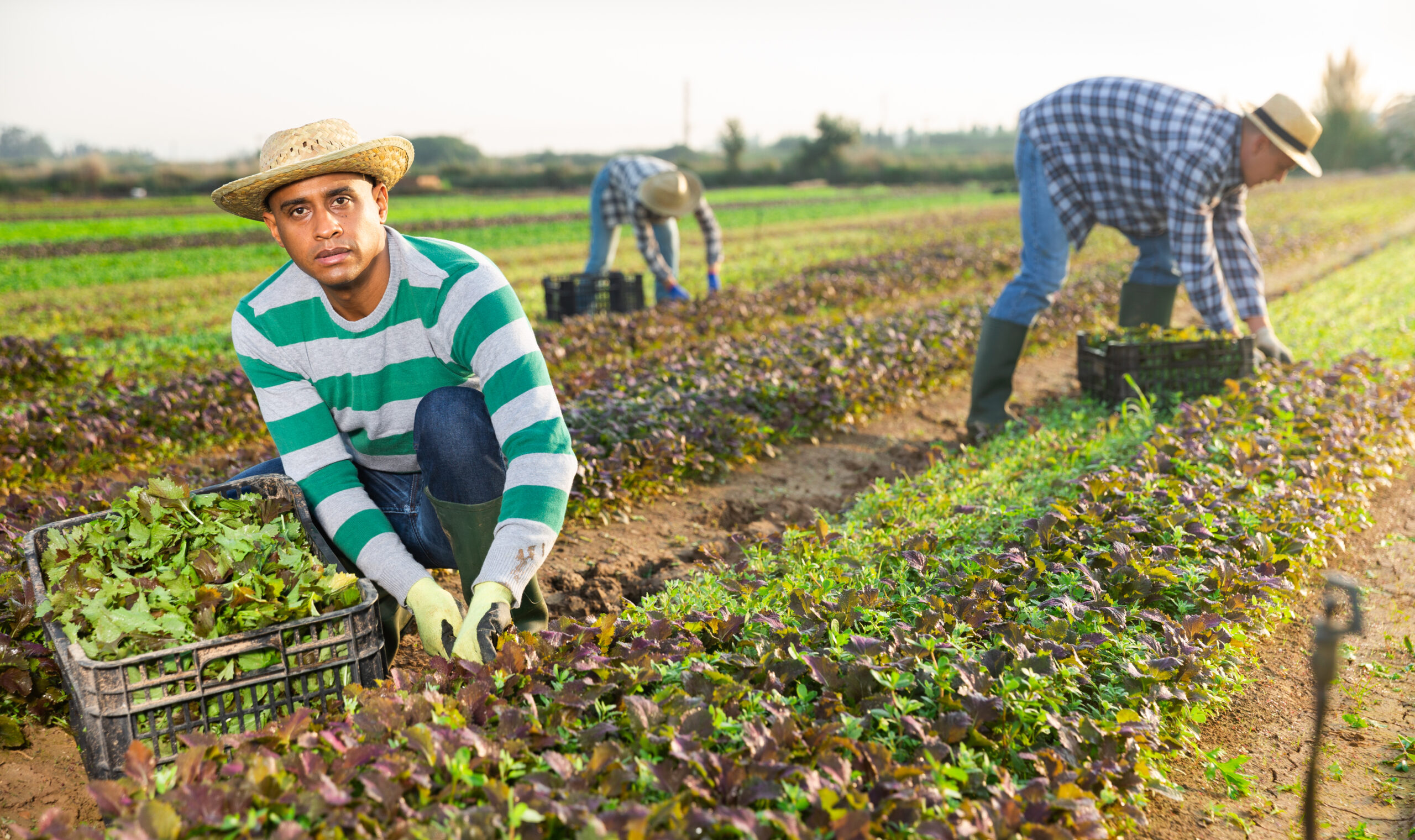
There is no accurate method for determining the precise number of people who are unauthorized immigrants. In 2022, the Office of Homeland Security estimated the number to be about 11 million.[2]
Keep in mind that the wealth of this nation is built on the backs of these hardworking, good and humble people. And the MAGA world led by Trump, many who are farmers, ranchers, contractors, hospital managers, CEOs and CFO’s of companies, and also ordinary citizens who directly benefit from the labor of migrants, have embraced the Trump scapegoating of them as “rapists, murderers, and criminals.” A few may be, but the vast majority of them are not!
(See: https://www.factcheck.org/2018/06/is-illegal-immigration-linked-to-more-or-less-crime/)
Bishop Mariann pleaded with the new President: rather than treat them as criminals, could he honor their dignity and show them mercy:
Let me make one final plea, Mr. President,…I ask you to have mercy…on those in our communities whose children fear that their parents will be taken away and that you help those who are fleeing war zones and persecution in their own lands, to find compassion and welcome here. Our God teaches us that we are to be merciful to the stranger for we were all once strangers in this land. May God grant us the strength and courage to honor the dignity of every human being, to speak the truth to one another in love, and walk humbly with each other and our God for the good of all people. The good of all people in this nation and the world.[3]

I completely agree with Bishop Mariann. However, I don’t think she went far enough. Rather than simply asking for mercy for migrants and refugees, Bishop Mariann ought to have proposed a solution that would benefit the country and probably give President Trump a new constituency of supporters: citizenship for all migrants and refugees who seek it and have no criminal record.
While in the seminary in 1976, I was part of a community of students who welcomed refugees from Vietnam, one who became my roommate. Lori and I helped resettle refugees from Cambodia in the 1980’s. The individuals we helped, and the thousands helped by non-profits across the country became good citizens, excellent employees, owners of small businesses, and taxpayers. The same happened after the passage of the Immigration and Reform Act of 1986 under President Reagan, giving men and women living in the US without documentation a path towards citizenship under certain conditions. Did some commit crimes? YES, but very few. Did most settle in, they and their children quickly integrating into American life? A resounding YES!
With Biden’s executive action on June 4, 2025, the southern border was tightened up and essentially closed. Border and migration tension have intensified under Trump. Now is the time to change direction. Stop deporting migrants and refugees who are here doing the grunt work that few native-born Americans want to do.
Lori and I and two of our daughters have worked on the border. We have seen firsthand the young, hardworking, resilient, courageous, creative, and intelligent men and women, many with their children, who have made the long journey from their home country to the USA. Their home countries are losing the best and the brightest, their greatest assets and talents, their youth, to migration.
The US is not being “overrun” by these migrants, we are benefiting from them! In giving the undocumented migrants and refugees a path to citizenship, Trump would succeed in keeping the harvest picked; the elderly and infirm well cared for; meat cut, packaged, and sent to stores; and small migrant-owned businesses continuing to serve the local community. After these welcomed migrants become citizens, they will remember at the next election which party cared for them and acted on their behalf.

Mass deportation of migrants and refugees is not the answer to their undocumented status. Citizenship is. Citizenship is in the US’s self-interest. It is also the just and Christian thing to do. It is how the Gospel mandate to welcome the stranger, feed the hungry, clothe the naked, care for the sick could be implemented nation-wide.
[1] https://carmenmccain.com/2025/01/22/transcript-of-bishop-mariann-budes-sermon-during-the-2025-us-inaugural-prayer-service/
[2] https://ohss.dhs.gov/sites/default/files/2024-06/2024_0418_ohss_estimates-of-the-unauthorized-immigrant-population-residing-in-the-united-states-january-2018%25E2%2580%2593january-2022.pdf
[3] https://carmenmccain.com/2025/01/22/transcript-of-bishop-mariann-budes-sermon-during-the-2025-us-inaugural-prayer-service/
The Lenten season that changed my life
By Robert Fontana
I was raised in a conventional Catholic family. Faith in God was tied to being part of a community of people that shared a culture based on specific practices: Mass on Sunday and holy days; praying the rosary, abstaining from meat on Fridays, etc. We were raised like the comedian Kathleen Madigan, who remembers how the nuns taught her,
“DON’T BOTHER JESUS! You have a guardian angel who’s with you 24/7; go to your him if you have a problem. You can turn to one of the saints; there’s one responsible for every facet of life. You can try Jesus’ mother – ask her for help. But DON’T BOTHER JESUS.”
Ok, maybe that’s a slight exaggeration.
We had a family Bible but never read it. Our only family review of Scripture was while praying the “mysteries” of the rosary which focused on Jesus’ birth, death, and resurrection. His life and teachings were assumed, I suppose, to be part of cultural Catholicism.
That all changed for my parents when, after 20 years of marriage, they weren’t getting along. Rather than going to a divorce court, they went to a Catholic Charismatic prayer meeting. Their lives were turned upside down. They met Jesus and the Holy Spirit in a surprising and beautiful way. They discovered God’s love for them and God’s will for them: to love one another. Their transformation became my transformation.
Throughout high school I struggled with all the things teenagers struggle with but what helped me to cope was daily Bible readings, prayer, and a desire to do God’s will. By the time I was a high school senior, I started hearing an inner voice that said, “Why don’t you become a priest?” I remember fighting it. “NO! I DON’T WANT THAT! I want to go to college, to watch football games, to date girls.”
God won that argument. I went to a college seminary situated on acres of pine woods north of New Orleans. It was my first experience of being in such a quiet environment with all boys and with NO GIRLS! I hated it.
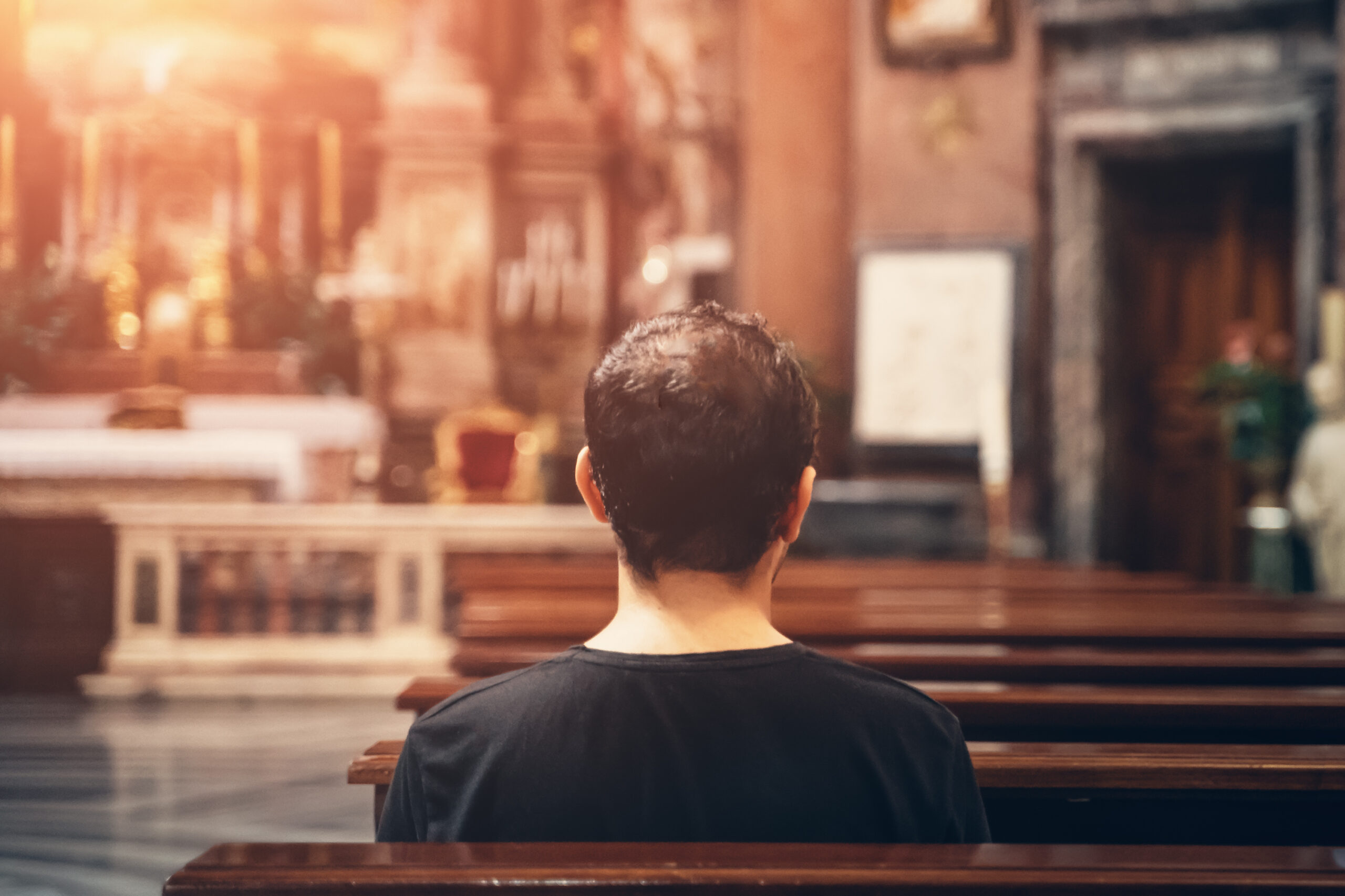
It took me a good month to transition to the rhythm of life offered by the Benedictine monks at St. Joseph Seminary. That life began with sung prayer of the Psalms at 6:15 in the morning, class beginning at 8:30 or 9 am, Mass at 11:15, more class, free time, and work study in the afternoon, evening prayer with the monks at 5:30 pm and night prayer with the seminarians at 9:30. I was being disciplined into a new way of being a Catholic follower of Jesus.
During a fall day of prayer, the retreat director, Fr. Ambrose, said something that seems simple and “duh” now, but at the time was very new to me. He suggested that we spend a lot of time outdoors and listen to “nature.” Many of my classmates laughed at his suggestion. Fr. Ambrose was a man who would not swat a mosquito sucking blood out of his arm because he wanted to learn something from the insect. Yet, for me, what he said struck me as truth.
I tried to tune in to nature during the day. The beautiful, natural surroundings touched me, had a calming effect on me. I would occasionally get up early before morning prayer and spend time alone at the nearby river.
When Lent came around the following Spring, Fr. Ambrose again gave us students a recommendation that I took to heart. He suggested that during these 40 days we remove one item from our room as an outward sign of removing an attachment in our heart that might be keeping us from loving God and loving my neighbor. That very night I resolved for Lent I would remove one item each day from my room, and I would begin each day with a half hour of silence at the river before morning prayer.
Something very profound began to happen to me. I became aware of the beauty, peace, and healing balm that nature had to offer me. By the time Holy Week came, my room was completely emptied of all items on my wall, bed, and bookshelf. My heart had become still, quieted by nature’s touch. I felt so close to God, at peace with myself and the world around me.
I learned from that Lenten journey what Moses, the prophets from the Hebrew Scriptures, Jesus, and the saints all knew from their life with God: nature is a primary place of encounter between God and humans.

In Catholic language, nature is a “Sacrament.” It is an “outward sign, something one can experience through the senses – seen, touched, and heard – instituted by God, that gives grace.” In fact, it is the original “Sacrament” upon which all other Sacraments are built. Without nature, there is no “burning bush” before Moses, no “cloud by day” leading the Hebrews from Egypt, and no Word of God becoming “flesh” in baby Jesus.
Once while praying in a nearby park whose trees and shrubs were left to grow wild and free, I felt like I was in the womb of love. I wrote a poem about my relationship with the Sacrament of Nature inspired by the words of St. Augustine and an old Catholic hymn. I share it with you below. May you take time this Lent to cultivate a deeper life with God by allowing nature that you have access to – from your garden or nearby park to a mountain stream or the vast ocean – quiet your soul and draw you into a beautiful encounter with God.
“How late have I loved thee, O Nature, ever ancient and ever new.
O Sacrament most holy, O Sacrament divine, how late have I reverenced you, bowed before your beauty, knelt before your mystery like Moses before the burning bush.
You give life and death. You water, plant seeds, grow forests, birth creatures, including me, and receive us in death.
I played in your fields, ate from your fruits, stole from your treasures, always thinking you and I are different, separate. I had forgotten that I came from you, and I will return to you. As the Scriptures write, “For you are dust, and to dust you shall return.” (Gen 3:19) Clearly, I am nature too.
Forgive me, O sacred friend, forgive me for loving you too late, way too late, and having caused you so much harm. Late have I loved thee, O Beauty ever ancient and ever new, but it is not too late for me to change.