“Robert, why should a couple work on their marriage?”
By Robert Fontana
“Robert, why should a couple work on their marriage?” This is a real question I recently received. Here’s my response.
When Lori and I were married back in the Stone Age – 1978 – we knew that we were going to have a great marriage. We were best friends, enjoyed doing so many of the same things, and were deeply rooted in our common faith in God.
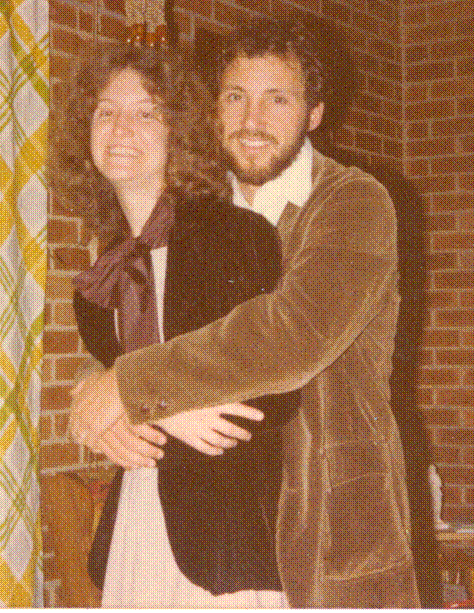
Fast forward to 1985. We moved away from family so that I could attend graduate school to study theology. We were having babies… following the Catholic family planning method…which means three kids in five years, and number four was a bun in the oven. I was working as a parish youth minister, mostly nights and weekends, going to school in the mornings, and studying during my “free time.”
You can imagine how Lori felt all those months while I was in school – like a single mom. We finally had a “come-to-Jesus” meeting. What became clear was that we had put our marriage low on the list of priorities so that we could respond to the demands of school, work, and children. It wasn’t “bad things” that had slowly pulled us apart, no drugs or alcohol misuse, gambling addiction, retail therapy, or another person. It was good things that we both valued.
We also discovered during this time of frank conversations that, although we were still friends and certainly loved each other, we had less in common than we first realized. This became clear when each of us wrote out what we needed from the other.
Lori’s list was:
1. Be home when you say you are going to be home.
2. When you arrive home, if the children are asleep, DO NOT WAKE THEM TO PLAY WITH THEM.
3. If there are dishes to be washed and diapers to be folded or I am comatose, there is no romance.
4. If you write a check, record a check (and correctly).
My list was:
1. Don’t sweat the small stuff.
2. Let’s be flexible.
3. Let’s be spontaneous.
4. When we’re home, play before chores. (I had a lot of growing up to do.).
Comparing our lists, we started to laugh. Lori was basically saying she wanted me to act like her, and I was saying that I wanted her to act like me. Essentially, we both wanted to be married to ourselves. What a nightmare that would be.
We had stumbled onto a “truth” that the marriage research gurus, John and Julia Gottman, have learned during 30 years of studying couple behavior: 70% of conflict between couples is based on this reality: Spouse A is not Spouse B; Spouse B is not Spouse A.
We finally addressed just how different we were from each other. Without realizing it, whenever we had a disagreement, we were in a kind of “tug-of-war” to see which one of us would get his or her way. Once we learned to accept how different we were/are from each other, we were able to do the slow and demanding work of finding unity and agreement on all issues.

We came to see that if the marriage was going to win, we had to work through an issue to the point that we both could live with it without resentment. Today, unity is so important in all that we do that with each issue that comes up, we want unity more than we want our own way!
By working on understanding one another and seeking unity in all things, we learned to make our relationship a priority. This was not easy. The demands of “good things” – children, work, church, chores, friends, and even extended family – were still crying for our attention. We learned to prioritize quality and quantity time for each other.
The fruit of this has been our developing love and friendship at a much deeper level than when we first married. Night after night we go to sleep with peace between one another. I think this is the peace that Jesus refers to as the peace that comes from him, “a peace the world cannot give.” (John 14:27)
Couples need to work on their marriage so that they do not take each other for granted and allow other good things to draw them apart. They also need to work on their marriage so that they can learn to negotiate their differences and stop trying to win a dynamic that cannot be won – Spouse A will never be Spouse B and vice versa.
When couples fail to negotiate their differences and take each other for granted, allowing other good things to have greater priority in the marriage, conflict can arise and intensify. When this happens, spouses open themselves to finding emotional comfort elsewhere – in work, alcohol, hobbies, church, shopping, or another person. All this can seriously undermine marital trust.

Work on your marriage and your marriage will work. Make sure every day you debrief with each other the good and not-so-good of your day. Build in fun – walks, Scrabble, foot massages – these are possible even with small children in the home. Read books together to continue to learn about how to better your marriage. Try to attend a workshop or retreat every 4—5 years as part of your marriage maintenance program.
If necessary, if the relationship frays, do not hesitate to seek out a therapist trained in couple’s conflict. If your car has signs of a motor problem, you rush it to the mechanic. Do the same thing with your marriage. Do not wait until resentment and distance are so great that the two of you can hardly talk to one another.
Work on your marriage and your marriage will bring forth the very thing that led to your getting married in the first place; friendship, fun, deep trust, loving intimacy, and peace.
This is why a couple should work on their marriage!
